
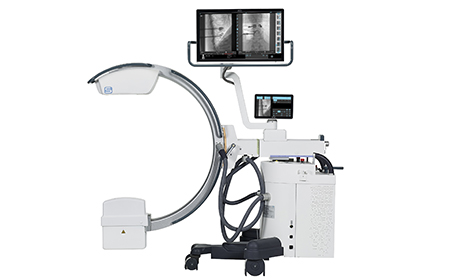

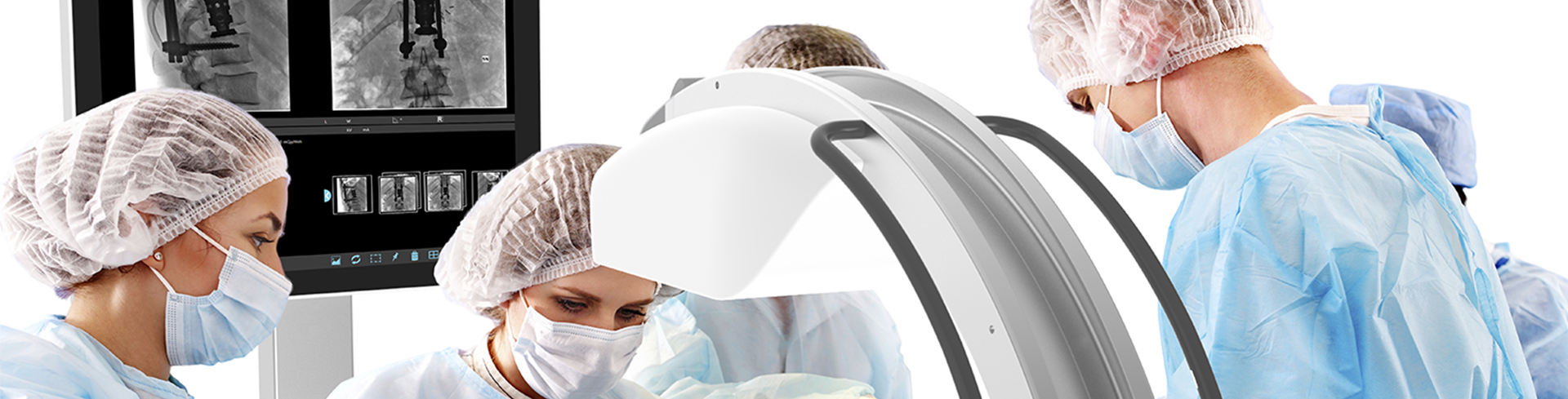
Stephanix mobile C-arms portfolio offer all the performance and versatility required for complete radiological procedures in the operating room.
Omniscop DReam-S C-arm system offers a compact, all-in-one solution designed for maximum adaptability, with a dedicated version for orthopedics with a 21×21 cm flat panel detector : Omniscop DReam-S Efficiency.
For higher power requirements, the Omniscop DReam mobile C-arm delivers up to 25 kW, ensuring superior image quality and advanced applications to support even the most demanding surgical environments.
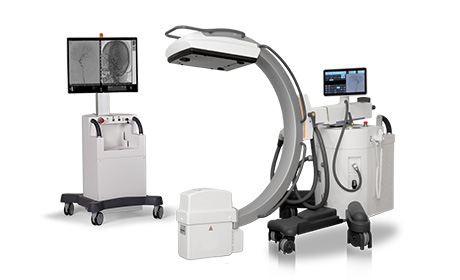
Our C arms machines are designed to meet the high demands of modern surgical environments, providing surgeons and healthcare professionals with an advanced medical imaging device that delivers high quality imaging for a wide range of surgical procedures. As part of our mobile surgical C-arms range, these systems combine real time imaging and precision to support complex and routine interventions alike.
Equipped with a state-of-the-art x-ray generator and fluoroscopy technology, our mobile C Arm x-Ray machines and c mobile fluoroscopy systems ensure clear, detailed images with increased X-ray power when required. This performance is essential for orthopedic procedures, emergency procedures, and other complicated surgical cases where accuracy and speed are critical.
Our c arm systems feature ergonomic designs that allow easy maneuverability within the operating room, ensuring seamless positioning around the patients for optimal access. With a dedicated c arm monitor for real time visualization, surgeons can make precise intraoperative decisions, enhancing both efficiency and patient safety.
Whether for orthopedics, trauma care, vascular interventions, or other specialties, our mobile fluoroscopy systems deliver consistent, radiographic imaging quality whith optimized radiation doses. From advanced c arm equipment to complete systems integration, we provide solutions that help surgeons and medical teams achieve superior clinical outcomes with confidence.
Mobile c-arm machines are designed for portability and flexibility, making them ideal for use in various medical settings. A C-arm machine consists of a flat panel detector, an X-ray source, and a C-shaped arm that connects the two. The X-ray source emits X-rays that penetrate the patient’s body, and the flat panel detector captures these X-rays and converts them into high-quality images. The C-shaped arm allows for precise positioning and movement, enabling medical professionals to capture images from various angles. Their compact design makes them easy to maneuver.
A c-arm machine uses advanced flat panel detector technology deliver high-quality images with optimizing radiation exposure. Flat panel detectors offer superior image resolution and clarity, essential for detailed visualization of anatomical structures.
C-arm machines are widely used in various medical procedures, including interventional radiology, orthopedic, spinal, vascular, digestive, cardiac and urological surgeries, and pain management. They provide precise imaging thanks to their ability to obtain real-time images during procedures allows for immediate adjustments and better outcomes.
The clinical versatility of a c-arm machine extends across virtually every surgical specialty. Orthopedic surgery accounts for the largest share of mobile c-arm utilization worldwide. Surgeons rely on real-time fluoroscopy to guide fracture fixation with plates and intramedullary nails, verify joint replacement component positioning, and confirm spinal pedicle screw placement with sub-millimeter precision.
Trauma care represents another critical application. When a patient arrives in the emergency department with a complex fracture or dislocation, the mobile c-arm provides immediate diagnostic imaging and intraoperative guidance without transferring the patient to a radiology suite. Speed matters in trauma; the c-arm delivers it.
Beyond orthopedics and trauma, mobile c-arms support a broad range of interventional procedures. Vascular surgeons use fluoroscopy and DSA to navigate catheters, deploy stents, and perform angioplasty. Urologists depend on real-time imaging during percutaneous nephrolithotomy and ureteral stent placement. Pain management specialists use fluoroscopic guidance to place epidural injections, nerve blocks, and spinal cord stimulators with pinpoint accuracy. Cardiac electrophysiology, gastrointestinal endoscopy, and neurosurgical procedures round out the clinical portfolio.
Real-time imaging is the defining advantage. Unlike conventional radiography, which captures a single static exposure, fluoroscopy provides a continuous live video feed. Surgeons see instruments moving inside the patient’s body as they operate. That immediate visual feedback shortens procedures, reduces the need for repeat imaging, and improves clinical outcomes by allowing intraoperative course corrections.
A mobile c arm x-ray machine offers exceptional flexibility and precision in the operating room. Its compact, mobile design allows for easy maneuverability around patients during surgical procedures, ensuring optimal positioning for real time imaging. Equipped with advanced fluoroscopy technology and a powerful X-ray generator, it delivers high quality imaging with the ability to adjust X-ray power to suit each procedure. Surgeons benefit from immediate, real time visualization on the dedicated monitor, improving decision-making during orthopedic procedures, vascular interventions, trauma care, and other complex surgeries.
Patient safety benefits are equally compelling. Modern flat panel detector c-arms deliver diagnostic-quality images at significantly lower radiation doses than older image intensifier systems. Pulsed fluoroscopy further reduces exposure by delivering X-rays in short bursts rather than a continuous beam, fully supporting ALARA (As Low As Reasonably Achievable) principles. For staff who stand near the X-ray source for hours each day, cumulative dose reduction is not a minor consideration.
Ergonomic design also plays a role that is easy to underestimate until you have spent an eight-hour OR day wrestling with a poorly balanced unit. Smooth, counterbalanced arm movement; intuitive touchscreen controls; and a compact footprint all contribute to reduced operator fatigue and faster patient throughput.
To provide the best possible experience, we use technologies such as cookies to store and/or access information on devices. Consenting to these technologies will allow us to process data such as browsing behavior or unique identifiers on this site. Not consenting or withdrawing your consent may negatively affect certain features and functions.

Le contenu de ce site internet est destiné exclusivement aux professionnels de santé.
Je certifie sur l’honneur être un professionnel de santé.